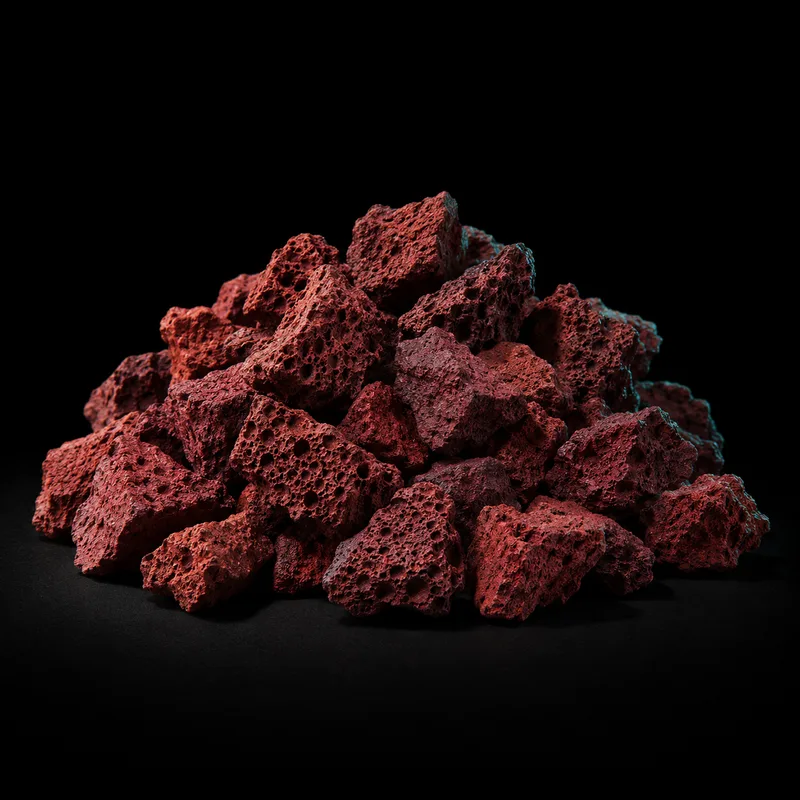
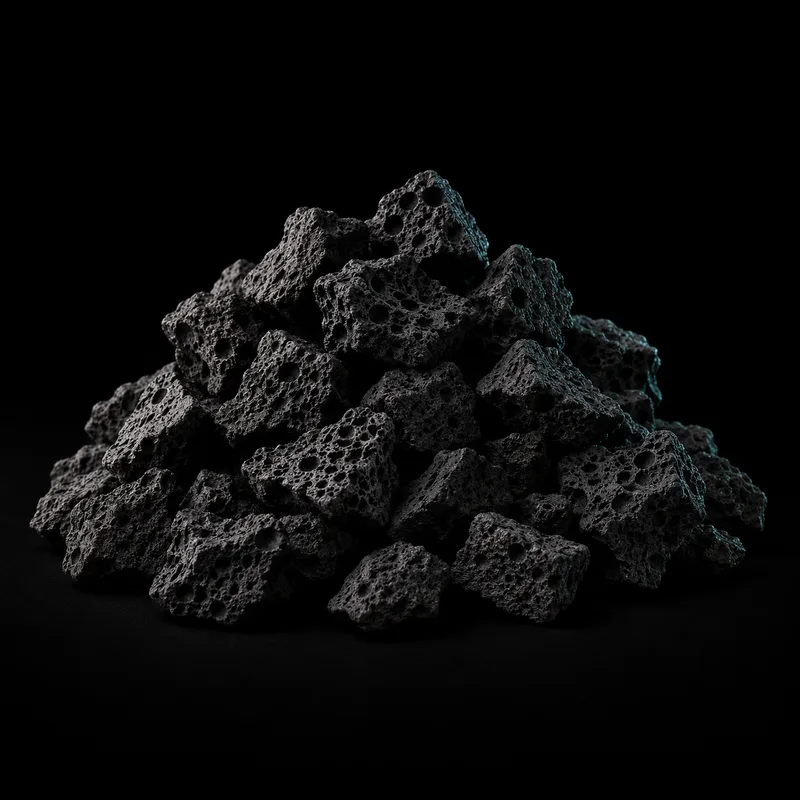
Suitable lava rock can provide surfaces in a biological filter, but the media alone does not define filtration capacity. Water movement, oxygen, mechanical maintenance, and gradual establishment matter more than a universal pounds-per-gallon rule.
Know which filtration job you are changing
Mechanical filtration catches particles. Biological filtration supports processes that change dissolved waste. A media compartment can involve both, but the distinction helps you diagnose what needs service. A pile catching debris is not necessarily operating well as a biological section.
The SRAC biofilter guide describes media colonization and the oxygen-dependent conversion of ammonia and nitrite. It also warns that high surface area must be balanced with reliable operation because media can clog. That is a reason to look beyond a porous appearance.
Do not describe new dry rock as already cycled. A clean bag does not contain an established filtration capacity just because microorganisms can eventually grow on surfaces. The system needs appropriate establishment and monitoring before it can support the intended load.
Confirm the material before installing it
The National Park Service explains the gas cavities in scoria. A geological texture is not a batch analysis or a usable-surface-area measurement. Avoid assigning a precise square-foot claim to untested stone.
Check treatment history, actual grade, and chemistry for the supplied product. The fact that media sits out of sight does not make its composition irrelevant. Swift leaves those chemistry questions unanswered until evidence is supplied. Do not infer inertness from a product category or a negative vinegar observation.
Inspect for fragments and loose fines. If suitable material is rinsed before first use, keep the dusty runoff out of the filter and display. Make sure the retaining screen can hold the actual pieces, including smaller irregular fragments rather than only the nominal grade.
Measure the usable compartment
Use internal dimensions and subtract space occupied by pipes, handles, grids, or a lid that must close freely. Check the maximum load and permitted media in the equipment instructions. A compartment should not be packed so tightly that it prevents baskets seating correctly.
The Fluval 07 series manual illustrates why actual filter instructions matter: it specifies a maintenance sequence, media handling, and precautions. Its instructions govern that equipment, not every possible DIY arrangement.
A removable mesh bag may help with handling, but its opening size, closure, and material need to suit the application. Leave enough room to lift it without spilling stones into the impeller chamber. Do a practice removal with the planned amount before filling a hard-to-reach compartment.
Follow the water path
Trace where water enters, which mechanical surfaces it passes, where the biological media sits, and where it returns. A drawing with those four points is often more useful than adding another bag. Check for bypasses where most water may avoid the intended path.
Keep the media section accessible. If solids arrive faster than you can remove them, a more tightly filled compartment may make maintenance harder. Adjust the system design with the equipment maker or an experienced specialist instead of assuming the rock needs no cleaning because it is biological.
Consider how flow will look after normal accumulation, not only when the system is newly assembled. Leave space for service tools and observation. An inaccessible extra liter of material can be less useful than a smaller section you can inspect and maintain reliably.
Compare 3/8 and 3/4 inch by handling
The smaller grade can be easier to distribute among confined spaces. The larger grade can be easier to handle individually. These are practical differences, not a proven ranking of biological performance for every filter.
Compare the actual media bag or basket with both grades. Can fragments escape? Can the material be removed? Does the load rest on a fragile grid? Does filling the space change how the lid or basket fits? Answer these before buying by the pound.
The calculator uses a provisional bulk density for ordering. If a compartment needs a measured volume, convert that volume to an estimated mass and allow the final practical fill to determine the result. Do not force surplus bags into a basket merely because the estimate was rounded up.
Maintain mature media differently from new dry stone
First-use dust removal and maintenance of an established biofilter are different tasks. Fluval's manual specifies rinsing biological media in aquarium water and avoiding soap or detergents. Follow the instructions for your actual equipment and media, and preserve the part of the system that is already doing useful biological work.
Avoid replacing all mature biological media at once just to achieve a fresh appearance. Plan changes in stages when appropriate and monitor the system afterward. A brown surface is not itself a measurement of filtration failure, while a visually clean filter is not proof that its biological capacity is intact.
Keep a maintenance log with dates, observed flow, and relevant water measurements. A gradually worsening service interval may point to a solids or flow problem rather than a need to keep adding rock. Use the log to distinguish a trend from one unusually dirty day.
Do not promise nitrate removal
Nitrification and nitrate export are different parts of water management. Ordinary biological media must not be advertised as eliminating every nitrogen compound or making water changes unnecessary. A claim about a specialized process needs evidence for that process and system.
Choose confirmed material and a maintainable layout, then assess the operating filter. Compare 3/8 inch lava and 3/4 inch lava by the compartment and the product facts. Continue with lava grading, lava evaluation, and pond-filter use.