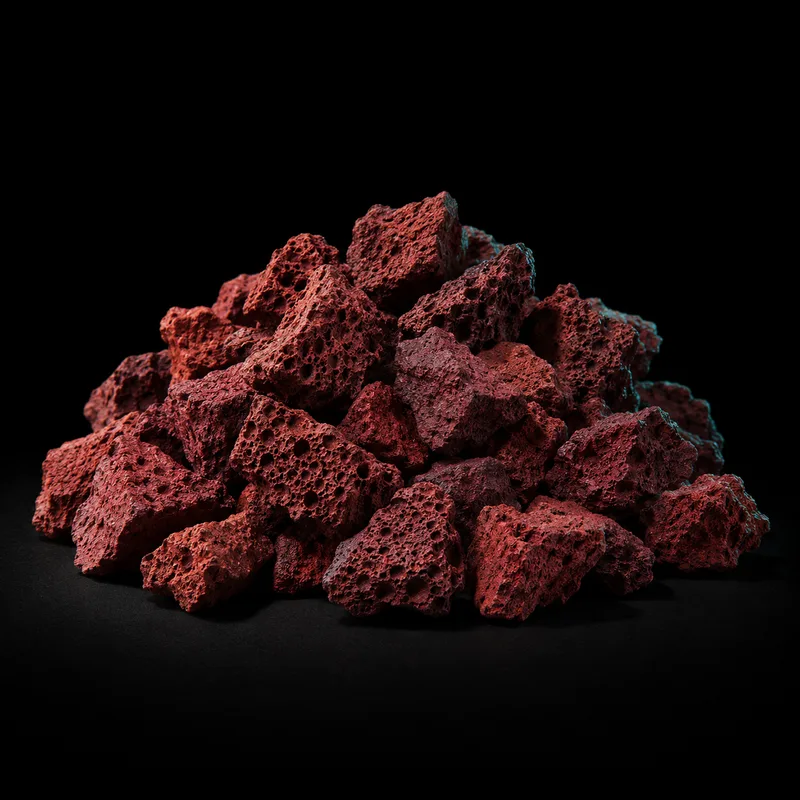
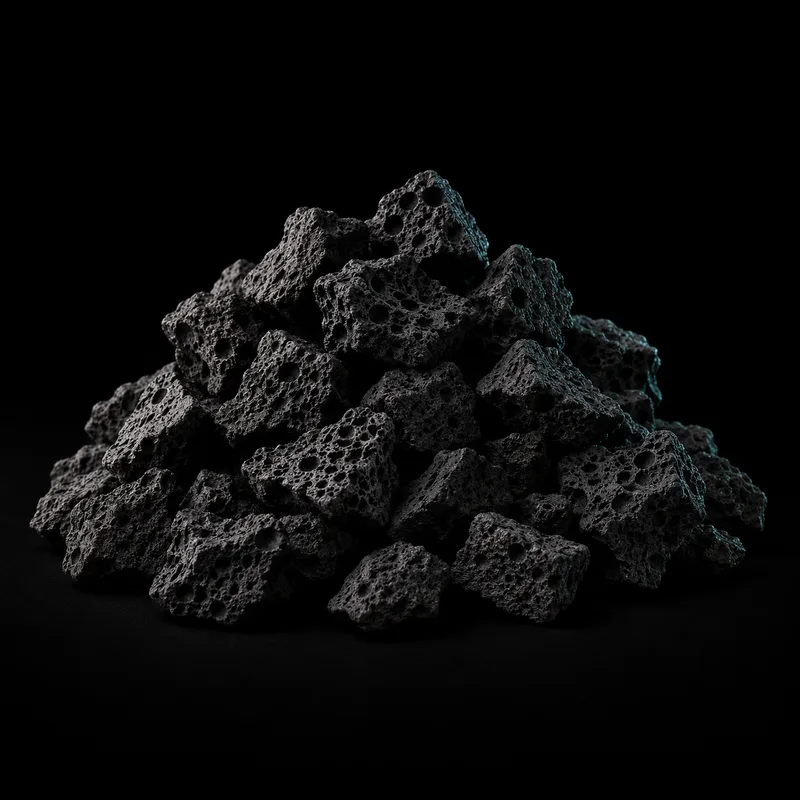
Choose 3/8 or 3/4 inch lava rock by the job, the actual piece shapes, and the space where it will sit. Neither grade is automatically a safe loose substrate or a guaranteed improvement in biological filtration.
Translate the grades into something useful
Three eighths of an inch is about 9.5 millimeters. Three quarters is about 19 millimeters. The larger nominal grade is twice the stated linear size, but a pile is not a set of identical cubes. Screening, irregular shapes, and fines mean you should not turn that ratio into a precise count or volume promise.
Lay a ruler beside an actual sample when one is available. Compare the openings in a basket or media bag, the space around plumbing, and the gaps animals can reach. A nominal grade is a starting point for those comparisons. It does not tell you the thinnest fragment that might break loose later.
Swift offers each color and grade on a separate product page. That makes it easier to compare an intended material without losing track of its bag weight. The 1 lb and 5 lb options describe how much you receive, not a different stone size.
For contained filter media, start with the container
Measure the usable compartment rather than its outside dimensions. Basket handles, central pipes, and retaining grids occupy space. Decide how you will remove the filled container and whether the bag can be closed without compressing the material against an impeller or seal.
Smaller pieces may be easier to distribute in a shallow basket. Larger pieces may be simpler to pick out individually. Both observations concern handling; they do not prove which will provide more usable biological capacity in your particular filter. Follow the filter manufacturer's instructions about allowable media and loading.
The SRAC biofilter guide explains why media area and reliable operation must be balanced. A packed arrangement that obstructs water is not improved merely by having more small pieces. Plan mechanical filtration, flow, oxygen supply, and access for cleaning as a system.
For a visible floor, the animal comes first
Lava has an irregular surface. Before using it where animals rest or search for food, ask how they interact with the floor. Some fish sift material through their mouths. Others can swallow pieces or get them caught. The MSD Veterinary Manual specifically connects substrate choice with those species-dependent behaviors.
Do not make a 3/8 inch grade a universal planted-tank floor because it looks close to familiar gravel. Plants are only part of the tank. The same aquarium may contain animals whose feeding behavior calls for a different surface. A contained layer and an exposed floor are different arrangements and need separate planning.
Likewise, a larger grade is not automatically safe for a turtle or a large fish. Actual mouth size, the ability to move pieces, gaps, abrasion, and the animal's growth all matter. Choose the floor from reliable care guidance for the species, then decide whether lava has any appropriate place elsewhere in the setup.
For hardscape, shape matters more than the bag label
A small irregular pile can be easier to knock apart than one larger supported piece. Before placing either grade, examine the surfaces and the way loads pass through the arrangement. Avoid relying on a thin point or a loose upper layer for support.
Sera's aquarium decoration guidance calls attention to rough lava surfaces. Keep that in mind where an animal might rush through a gap or scrape against an edge. Leave broad routes for movement rather than creating a maze of tight openings.
Dry-fit a low arrangement where you can see all of it. Check the view from the front and side, then consider how it will change after planting. Keep equipment service routes open. A piece that blocks a heater, intake, or cleaning tool creates work every time the aquarium needs attention.
For humid enclosure drainage, distinguish the layers
A drainage layer is below the animal-contact soil rather than the floor the animal walks on. The separation, access, water management, and ventilation are parts of the design. Simply naming a lava grade does not establish an enclosure's suitability.
Confirm the actual material before using it, and choose depths from the complete enclosure plan. Keep a way to observe or remove excess water. A layer builder can estimate volume and weight, but it cannot assess an animal's husbandry needs or approve an unconfirmed ingredient.
If the mesh or separator is part of the design, account for it separately. Swift does not supply mesh. Avoid presenting an incomplete materials order as a complete working enclosure merely because the stone quantity is calculated.
Order from volume, then check the bag mix
Suppose a compartment needs half a cubic foot of suitable material. If its estimated bulk density is 50 lb per cubic foot, the planning mass is 25 lb. This is a worked example using the launch estimate, not a certified density measurement. Grading, handling, and moisture can affect the actual fill.
Compare 1 lb and 5 lb bags at the current prices, then let the cart produce the box plan. A small top-up and a large base layer can have different economical bag mixes. Check both merchandise cost and shipping; the cheapest unit price alone does not describe the whole order.
A useful ordering note names both the stone grade and the container opening. For example, write the basket's measured depth and screen size beside the intended 3/8 inch grade. Keep a sample bag out of the final assembly until you have checked actual fragments. This prevents a nominal dimension from becoming an assumed equipment clearance.
Use black 3/8 inch or black 3/4 inch only after the product's confirmed information fits the intended use. Read lava as filter media, how much substrate to buy, and stable hardscape planning for the next steps.